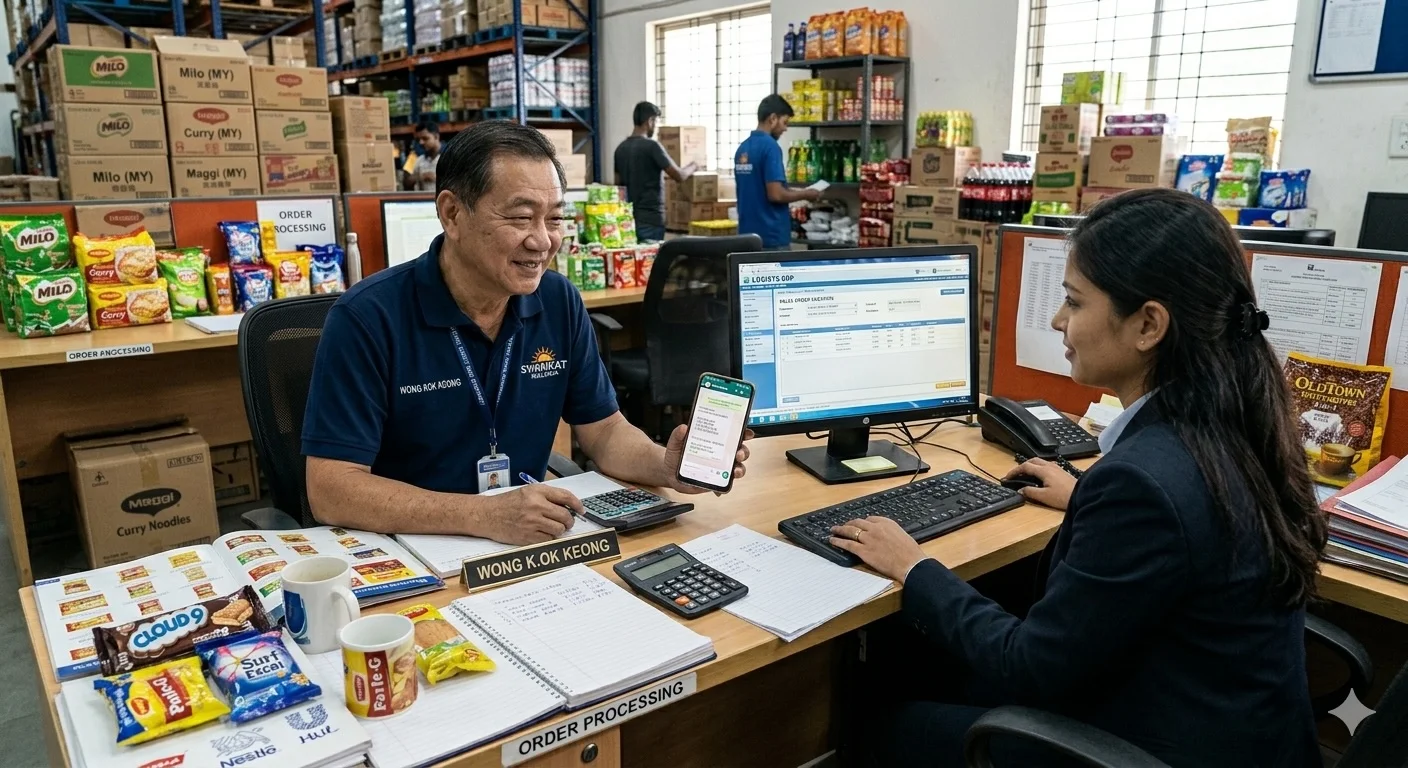
FMCG distributor AP automation is now one of the most commercially urgent applications of AI in Malaysian and APAC supply chains. Distributors handling hundreds to thousands of orders per week across multiple channels are facing a hard ceiling: you cannot scale throughput without scaling headcount — unless you automate.
The FMCG Distributor's Order Problem
Fast-moving consumer goods distribution is a volume game. Dozens to hundreds of retailers, supermarkets, convenience stores, and F&B outlets place orders every day. Orders arrive in every format: a WhatsApp message with a product list, an email with a PDF purchase order, a Telegram photo of a handwritten order form. Each one needs to be read, understood, keyed into the accounting system, and acknowledged — before the next batch arrives.
For FMCG distributors in Malaysia, this creates a specific bottleneck at the sales ops level. Sales ops staff spend the bulk of their day on order intake — not relationship management, not exception handling, not business development. They're reading messages and keying numbers. And because orders come in throughout the day and evening, the work never cleanly ends.
The risk is compounding. A missed order means a retailer runs out of stock. A keying error means a wrong quantity ships. A delayed acknowledgement means a buyer switches to a competitor who responds faster. In FMCG distribution, operational speed and accuracy are directly linked to customer retention.
How Rich Handles 2,000 Orders a Week
FlowGo's Rich agent is purpose-built for high-volume order capture across multiple channels. For FMCG distributors, Rich connects to your WhatsApp Business account, email inbox, and Telegram channel simultaneously. Every incoming order — regardless of format or channel — is captured automatically.
Rich extracts the order details: buyer identity, SKUs or product descriptions, quantities, requested delivery dates, and any special instructions. It maps products against your catalogue, resolving the common variations in how different buyers describe the same product. The matched order is then converted into a sales order in your accounting system — AutoCount, SQL Account, QuickBooks, Xero, or SAP Business One — without any human input required for routine orders.
For FMCG businesses running large catalogues with hundreds of SKUs, Rich's catalogue-matching capability is particularly valuable. Buyers often use shorthand, regional brand names, or inconsistent units. Rich handles this intelligently, flagging only genuine ambiguities rather than stopping on every minor variation.
Real Results: A Leading Beverage Distributor in Malaysia
The productivity shift was immediate. Order processing — previously a full-day, multi-person operation — became a monitoring and exception-handling task. The team now reviews flagged items and handles escalations rather than processing the routine majority. Customer acknowledgement times dropped from hours to minutes, reducing inbound chasing calls significantly.
The accuracy improvement mattered too. Keying errors that had previously created fulfilment issues and customer complaints effectively disappeared. Every order has a clean digital record tracing back to the original message, making disputes trivial to resolve.
Frequently Asked Questions
The Rest of the Workflow
Rich and Lizzie handle the volume coming in. One more agent checks that what you were billed is what you actually got.
Mei — Receiving matches every supplier invoice against your purchase order and against what the warehouse actually received. Short deliveries, wrong quantities and quiet price increases surface before you pay, not after.
How does FMCG order automation handle orders from hundreds of different buyers?
Rich maintains a buyer profile for each of your accounts, learning their ordering patterns, preferred product descriptions, and typical order sizes over time. When a new order arrives from a known buyer, Rich applies that buyer's context to improve matching accuracy. New buyers are onboarded automatically — Rich creates a profile from their first order and refines it with each subsequent interaction. There's no manual buyer setup required beyond your existing customer records in your accounting system.
Can AP automation help FMCG distributors with supplier invoices as well as customer orders?
Yes. FlowGo's Lizzie agent handles the accounts payable side — capturing invoices from your FMCG principals, importers, and local suppliers. Lizzie and Rich work together so your full order-to-cash and procure-to-pay flows are both automated. Supplier invoices arriving by email or WhatsApp are captured by Lizzie, extracted, matched to purchase orders, and posted to your accounting system. You get a complete picture of both incoming orders and outgoing payables without manual processing on either side.
What happens when a buyer sends an order with items that aren't in the catalogue?
Rich flags the unrecognised item for human review rather than processing an incomplete order. Your team is notified with the original message and the specific line item that needs attention. Once the item is resolved — either by confirming a catalogue match or updating the product list — Rich notes the resolution for future reference. This exception rate typically drops significantly after the first few weeks as Rich learns your catalogue coverage and your buyers' ordering vocabulary.
Does FlowGo comply with Malaysia's e-invoicing requirements?
FlowGo integrates with accounting systems that support LHDN e-invoicing compliance, including AutoCount and SQL Account which have built-in e-invoice capabilities for the Malaysian market. When Rich creates a sales order and it progresses to invoicing in your accounting system, the e-invoicing workflow follows your existing accounting system's compliance configuration. FlowGo's role is to ensure the data is accurate and complete before it reaches that stage — reducing the risk of e-invoice rejections due to data errors.
Processing hundreds of FMCG orders a week manually?
Book a Demo on WhatsApp